
When Chocolate Meets Temperature Sensors:
How Zetti Gains New Insights into the Cooling Process with Comprehensive Temperature Monitoring of the Cooling Channel
In addition to the recipe, raw materials, and processing, temperature control also plays a crucial role in ensuring quality, stability, and consistent results.
For Zetti, a brand of Goldeck Süßwaren GmbH, reliable and precise temperature monitoring of the cooling channel is therefore essential. Even small temperature differences within the cooling channel can affect the cooling process and, consequently, the properties of the products.
But how is the temperature actually distributed across the entire length of a cooling channel? Where do different temperature zones occur? And how stable is the cooling process over longer periods of time?
To answer these questions more precisely and identify specific opportunities for optimizing the cooling channel, Zetti worked with Flexora to investigate the temperature distribution in a 10-meter-long cooling channel. For the study, a 0.5 mm-thin, flexible, self-adhesive Thalis sensor solution with 20 cooling channel temperature sensors was installed along the cooling channel.
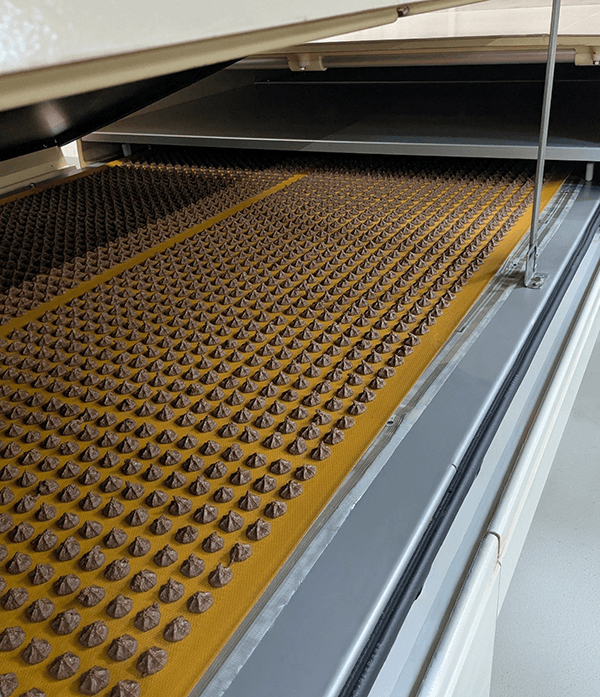
20 temperature sensors over 10 meters: Comprehensive monitoring of the cooling process
Using Flexora GmbH’s Thalis temperatur sensor foil, the temperature was continuously and comprehensively measured across a ten-meter measurement section at 20 sensor positions. This provided a detailed picture of the thermal conditions along the entire cooling line.
The temperature measurements in the cooling channel focused on three key questions:
- How does the temperature develop over the measurement period?
- What differences occur between the beginning, middle, and end of the cooling channel?
- How large are the temperature variations and short-term fluctuations in the measured values?
The combination of multiple temperature sensors throughout the cooling channel enables a much more comprehensive analysis than a single-point measurement.
Temperature monitoring in the cooling channel with temperature sensors throughout the entire measurement period
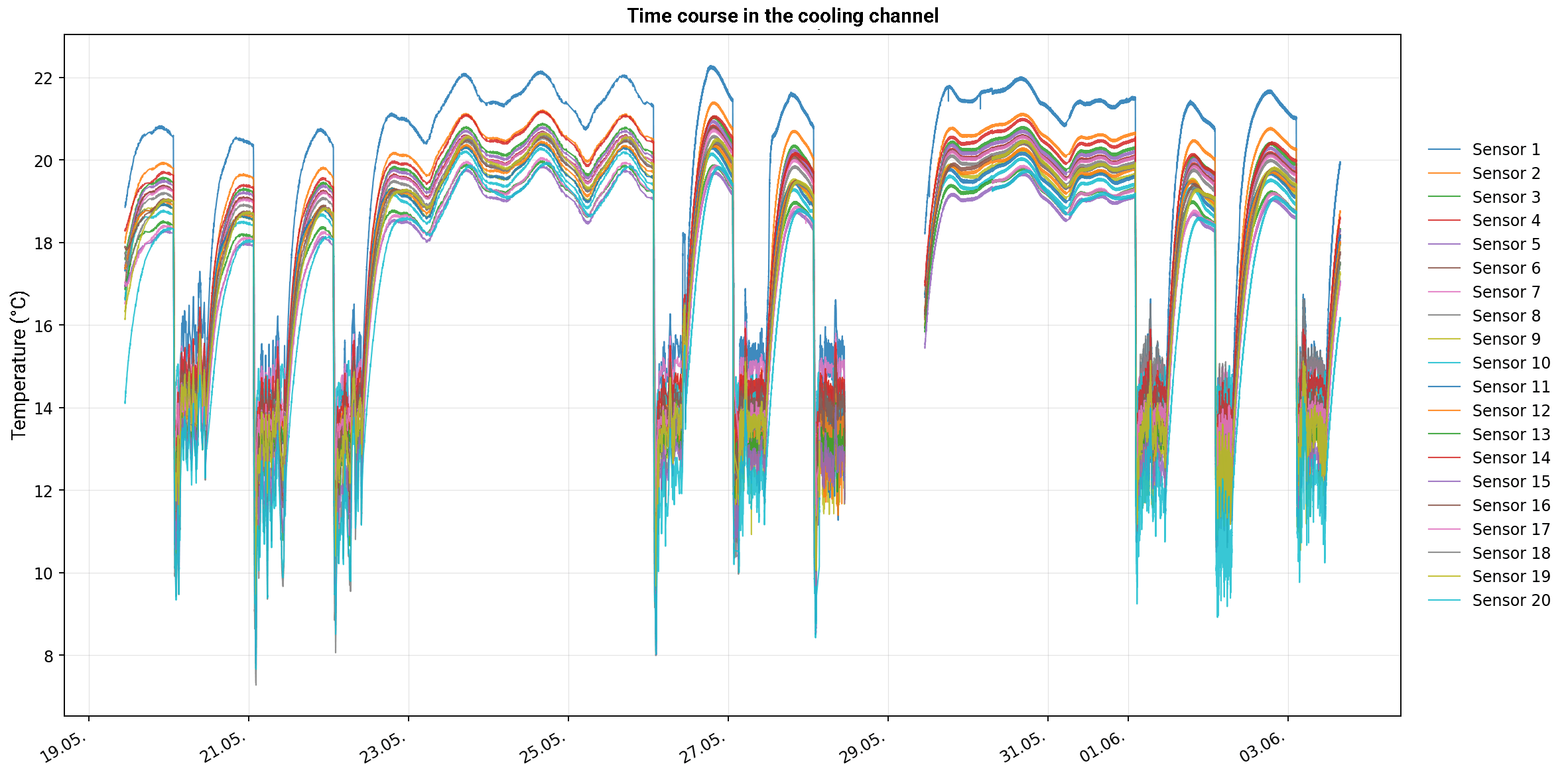
All measurement points follow the same temporal pattern but are at different temperature levels. The temperature difference between the beginning and the end of the cooling channel remains consistent along the cooling line.
This makes it clear that the temperature does not change only at individual points, but forms a continuous thermal profile across the entire cooling line.
This is where the advantage of comprehensive temperature monitoring of the cooling line with multiple temperature sensors becomes apparent: with 20 measurement points instead of two, it becomes visible whether a temperature difference is persistent or only occurs temporarily.
Precise temperature measurement in the cooling channel: High-resolution temperature distribution instead of single sensors
To examine the spatial temperature differences in greater detail, the temperature profiles at the beginning, middle, and end of the cooling channel were analyzed.
Across the entire cooling line, the temperature generally follows a comparable temporal pattern, while the individual areas remain at consistently different temperature levels. This results in a continuous temperature gradient between the beginning and the end of the measurement section.
The result: The cooling channel exhibits a stable spatial temperature gradient.
Rather than considering individual temperature values in isolation, the Thalis sensor foil enables the temperature profile of the cooling channel to be analyzed as a continuous picture. This makes it possible to identify whether a change occurs locally or extends across the entire cooling line.
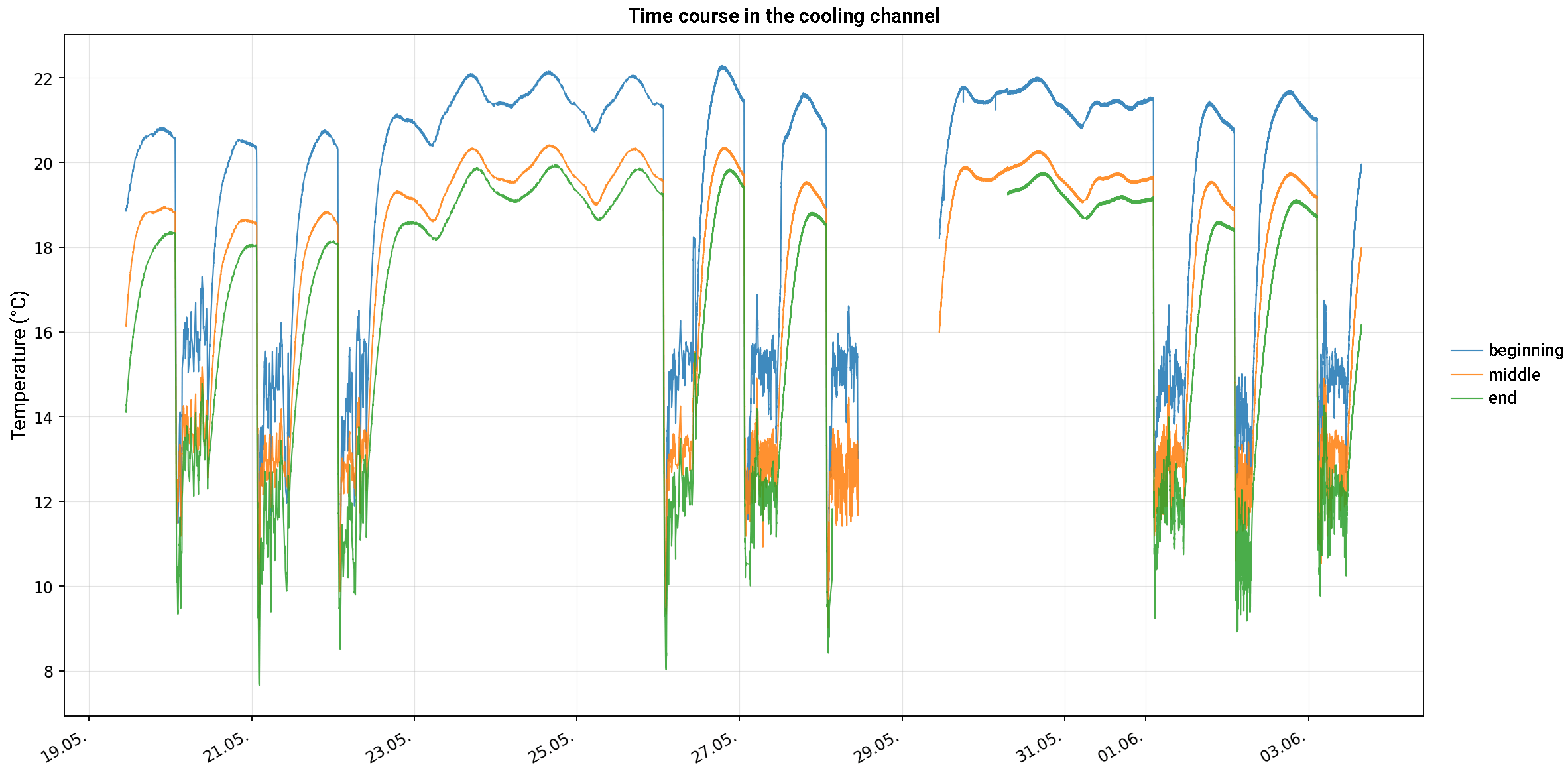
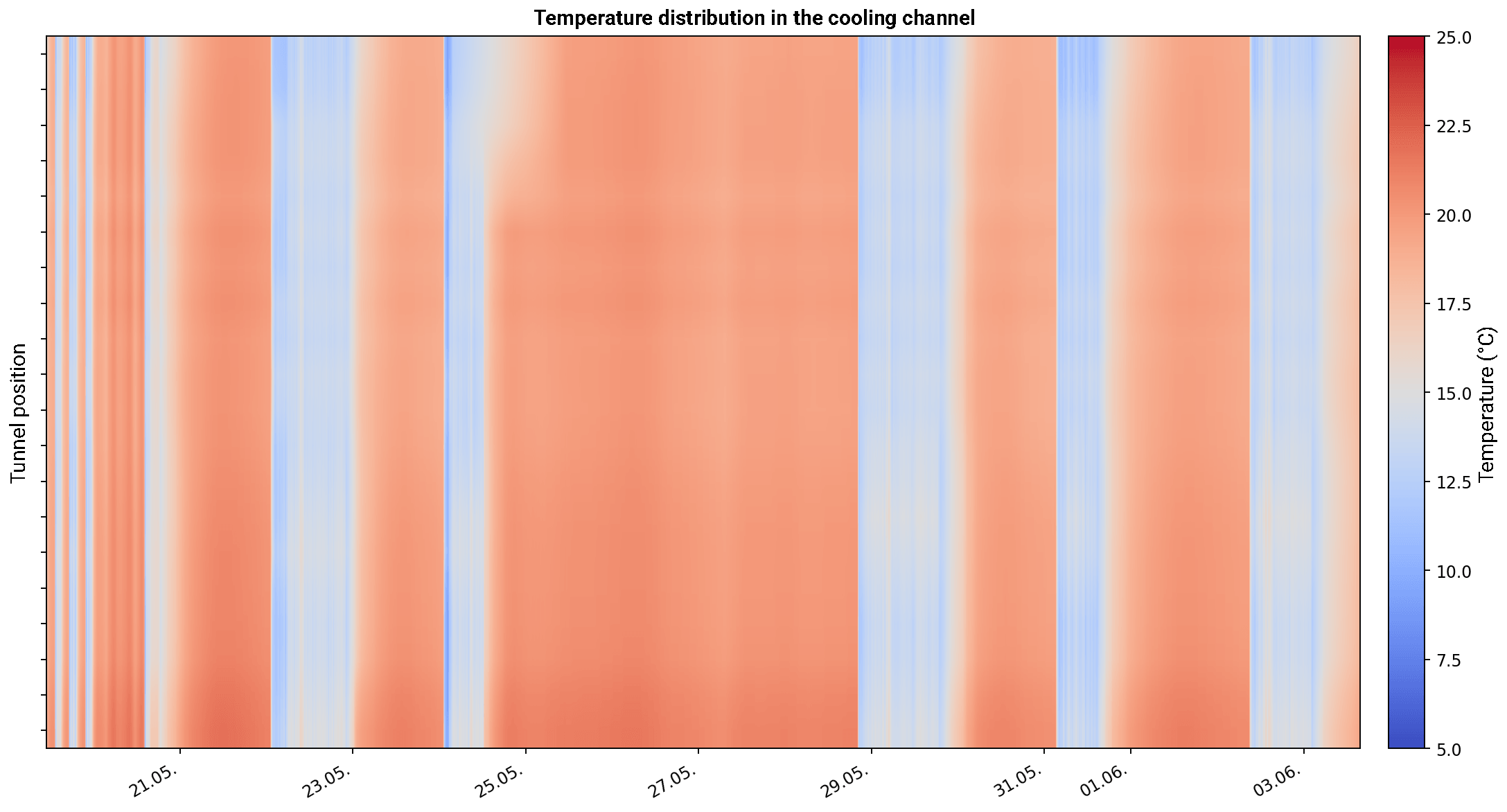
A single temperature sensor in the cooling channel tells only part of the story.
The strength of Flexora’s measurement lies in combining the temporal temperature profile with spatial temperature comparisons. This creates a continuous, spatially resolved picture of the process – a thermal map of the entire cooling process.
Temperature variation: how uniform is the cooling process?
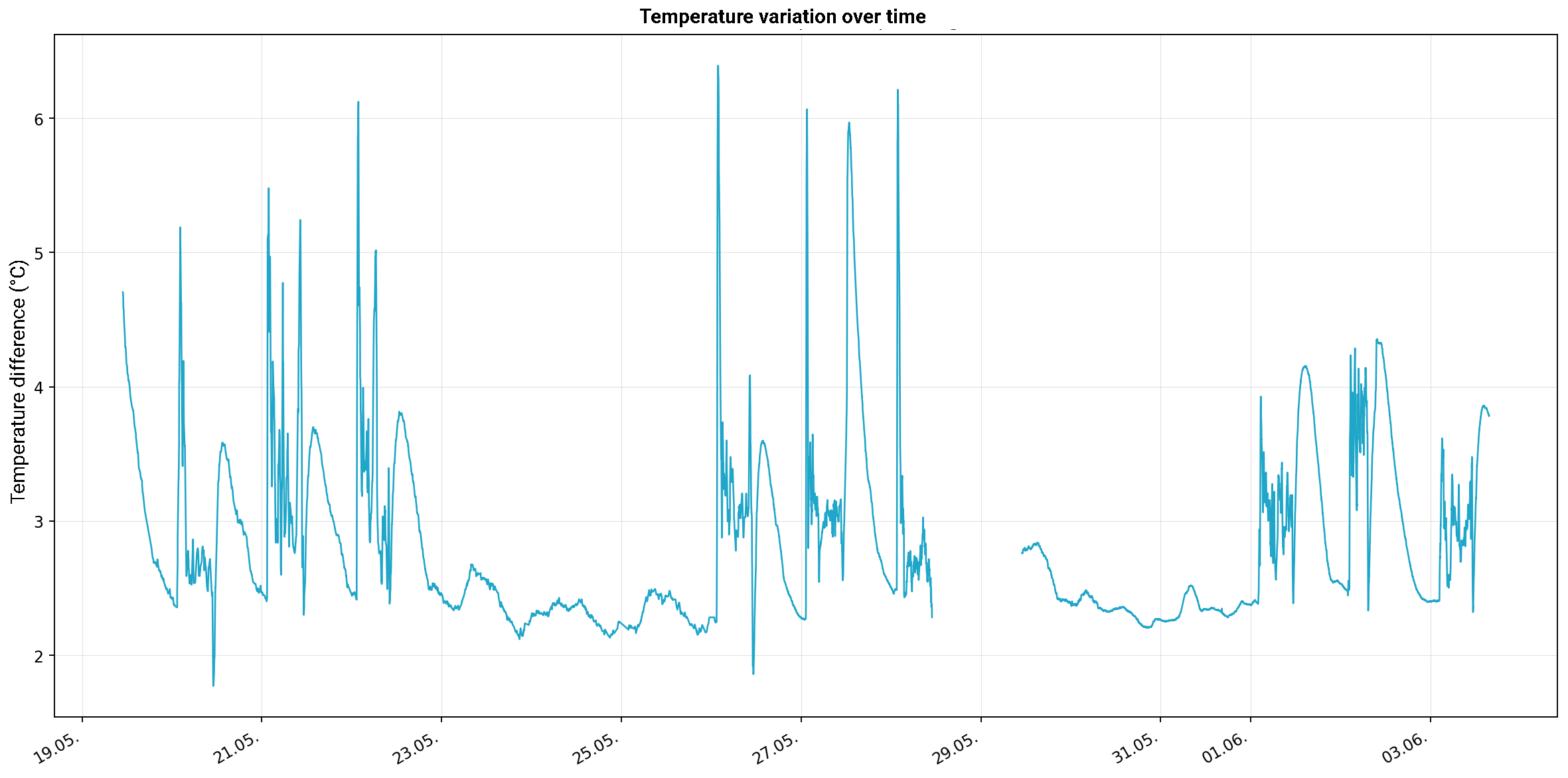
To assess the uniformity of the cooling channel, the temperature variation was analyzed. Temperature variation describes the difference between the warmest and coldest sensor position at a given point in time. It is a direct indicator of how evenly the temperature is distributed along the cooling channel.
The analysis shows:
- Average temperature variation: 2.9 °C
- 95% of measurement points: variation below 4.2 °C
- Maximum temperature variation: approx. 7.0 °C
- Measured temperature range: 7.3 °C to 22.3 °C
- Average temperature: 17.7 °C
Throughout the entire measurement period, there is a consistently persistent temperature difference of at least approximately 2.0 °C between the beginning and the end of the measurement section.
The cooling channel therefore exhibits a stable spatial temperature difference. Larger deviations occur only briefly and indicate switching operations within the cooling process.
With 20 measurement positions, it is therefore possible not only to determine that temperature differences occur within the cooling channel, but also to identify where and when they arise and how they change over time.
Short-term noise: how stable is the cooling process?
In addition to the spatial temperature distribution in the cooling channel, short-term measurement behavior was also analyzed.
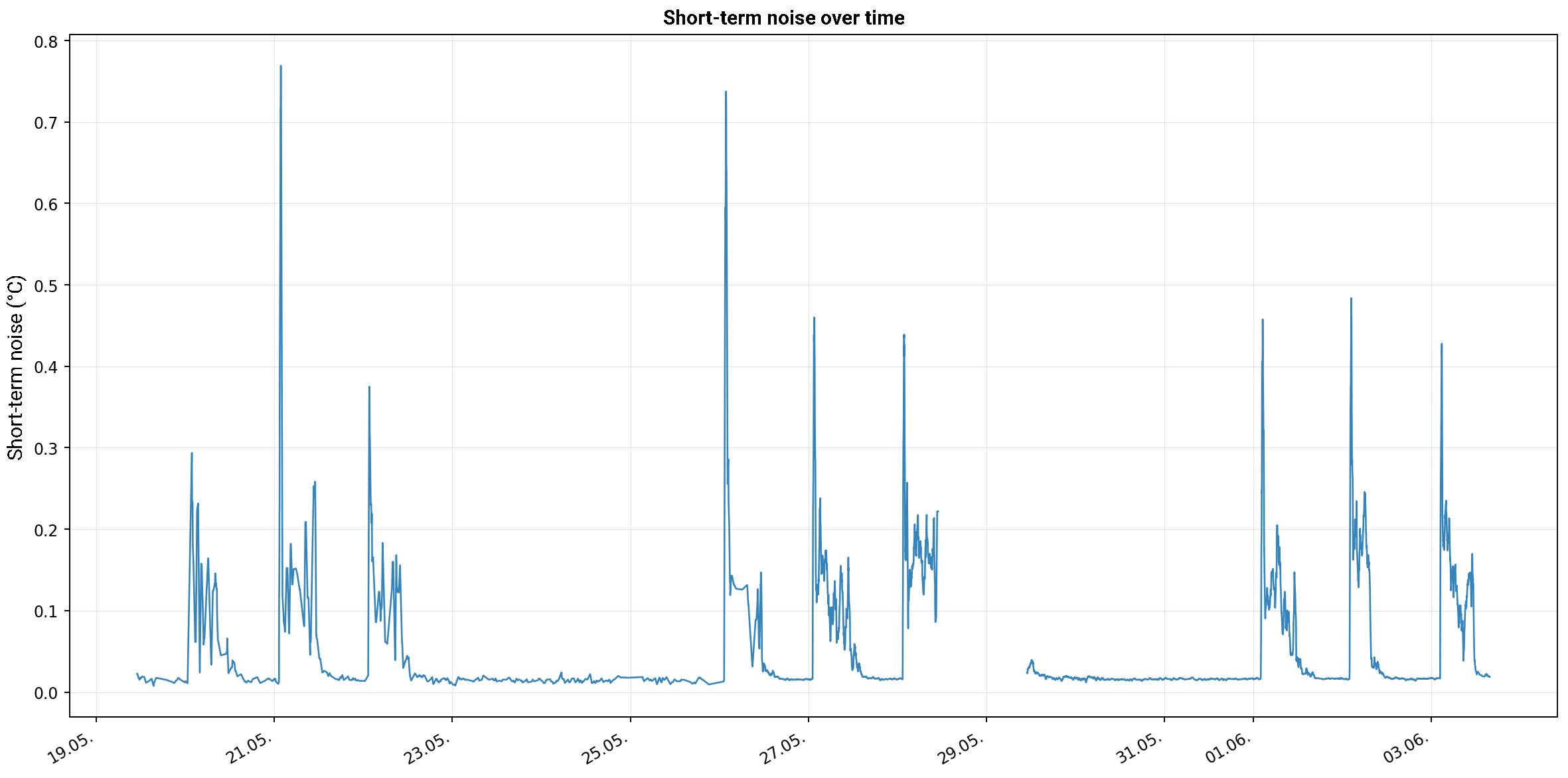
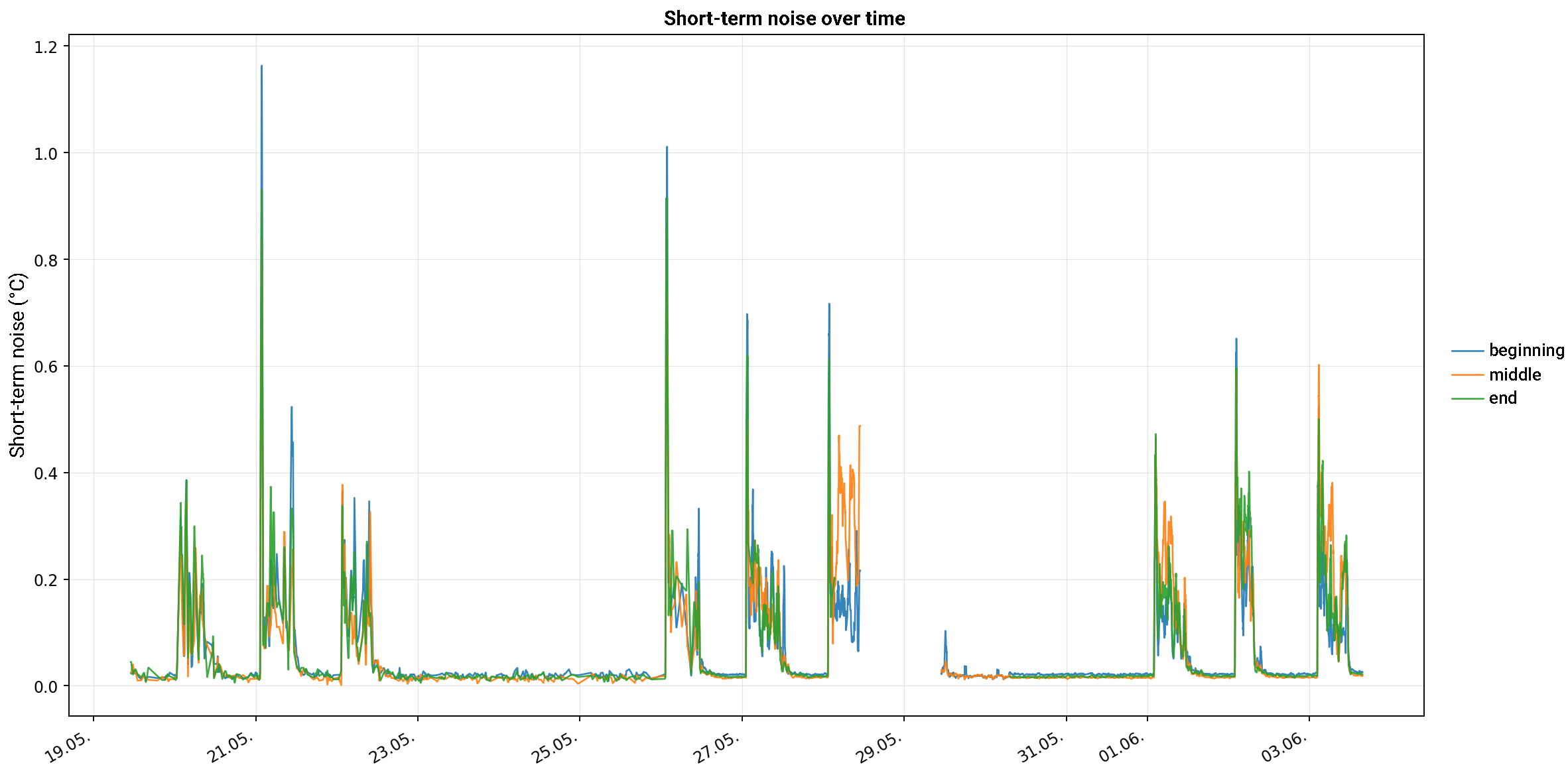
Short-term noise describes the local variation of the measured values around a smoothed temperature profile. It serves as an indicator of the stability of the set temperature, with obvious cooling start-up and shut-down events excluded from the analysis.
The results:
- Control deviations are predominantly in the range of: 0.1 °C to 0.2 °C
- Individual peaks reach: up to 0.7 °C
Between the beginning, middle, and end of the temperature sensor foil, no significant differences in control quality were observed. The quality of temperature regulation therefore does not depend on the position along the cooling line.
Here too, Flexora technology offers a decisive advantage: the Thalis sensor foil captures short-term behavior not just at a single point, but across the entire length of the cooling line.
This makes it possible to determine whether fluctuations are localized or occur systematically throughout the entire process. At the same time, the high spatial resolution makes it possible to assign short-term changes to specific sections of the cooling line or to confirm that they are evenly distributed throughout the cooling channel.
Greater transparency for quality and cooling channel optimization through high-resolution temperature monitoring
For Zetti, the existing temperature sensors already provided reliable information at individual measurement points. Flexora GmbH’s sensor foil makes it possible to visualize how the temperature behaves between these existing measurement points and how the temperature level changes along the entire cooling line.
This transforms individual temperature readings into a continuous, spatially resolved process picture and a thermal map of the entire process.
The key insight from the project can also be applied to other industrial applications: a single temperature sensor provides only a point measurement. Comprehensive, spatially resolved sensor technology makes thermal processes visible across the entire area.
Temperature monitoring along the cooling tunnel offers several benefits:
- Complete transparency into the actual condition of the system
- Data-driven optimization and stabilization of temperature control and production processes
- Improved quality monitoring and process documentation
- Early detection of temperature deviations and process disruptions
- Faster commissioning and more efficient process analysis
- Improved energy efficiency and operational safety
- Support in meeting quality, compliance, and ESG requirements, as well as in implementing energy management systems in accordance with ISO 50001
Ultimately, it is product quality that benefits. With precise temperature monitoring, Zetti is not only able to optimize its cooling tunnel, but also supports exactly what matters to consumers: the perfect crispy flake.